Mark Longair, who I was lucky enough to count as a friend for more than 20 years and work with for two, died last Saturday, 10 January 2026, aged 49.
After Mark published his blog post the previous Sunday, I wrote him a letter on Tuesday, intending to send it at the weekend, but on Saturday afternoon Duncan phoned to say that Mark had died. So, now it is too late. Always send the letter.
Sometimes in life, you meet people who really do seem to live by a moral code, beyond kindness. Mark was like this. One thing I wrote in my letter was:
There is a Latin word virtus that means strength and intelligence and character and a kind of civic virtue, this is the word I think of when I think of you.
But virtus is also too martial for Mark. I thought about this more this week, when I learned that Mark had an ancestor who, as well as being the scientist who first classified clouds, was a prominent Quaker. (If I had a relative this interesting, I would talk about it constantly, but Mark never mentioned it.)
Mark was not religious when I knew him, but learning he had Quaker ancestry makes sense to me. He was someone who cared deeply about doing things well, worked hard, was endlessly considerate of others, self-examining, humble, and civic-minded. The Quakers talk about “continual unspectacular acts of kindness”, which is a fair description of Mark.
The only problem with all this was that Mark was often hard on himself, as you can see a bit in this post on mediocrity (as if). It didn’t look easy to be him. But this made him easy to be around, because he was open about his feelings in a way that set everyone else free.
All this risks making Mark sound annoyingly virtuous, which he wasn’t. He had a sharp wit (and would politely make it clear when one was being a dick); a love of good food; and a spectacular karaoke rendition of Call Me Maybe.
He was a man of many interests, including but not limited to: restaurants, crosswords, serious music (his wife Jenny was previously a classical musician), books, Dance Dance Revolution, karaoke, the great TV works of our age, board games, climbing, technical management, geospatial data, parkrun, actual science, clothes, civic tech, Bake Off and a million other things.
I keep remembering more things. Mark had strong views on Unicode, and once made an A0 poster of every Unicode character. Mark knew everything a person could know about git. Mark could do calligraphy!
I first met Mark in 2003, in Cambridge, via a group of geeky friends originally from Clare that had expanded to include hangers-on like me. Mark was doing a PhD in Edinburgh by then, so just visited sometimes: I remember a mysterious softly-spoken half-Scottish person, bringing grace and decorum to an often raucous group.
Mark then went to Zurich for post-doc, then he and Jenny came back to London, and he worked for mySociety for six years. During this period, he also wrote the first version of Democracy Club’s candidate finder, in his spare time.
We worked together after Mark joined Flourish in 2018. The startup was going through a wobbly phase, as startups do, and he played a crucial role in steadying the ship. He and I did a lot of recruitment together: it was a joy to work with someone so careful and thoughtful about tech, management and culture.
Mark and Jenny had children in recent years, and though I didn’t see as much of him in his new role as a father, I know he adored it. And he did so many other things: made serious contributions to open source tools, and was a prolific StackOverflow answerer. (Thank you, Mark, thank you, on behalf of hundreds of thousands of anonymous, baffled git users.)
In my letter I also wrote:
You have always taken things seriously, tried so hard, always been thoughtful and always gentle. I have never known anyone who is so expert about computers and books and people, and who has so much reason to be arrogant and yet is so kind.
I don’t think I’ve ever met anyone as universally liked and loved by the people who knew him, and we will always miss him.
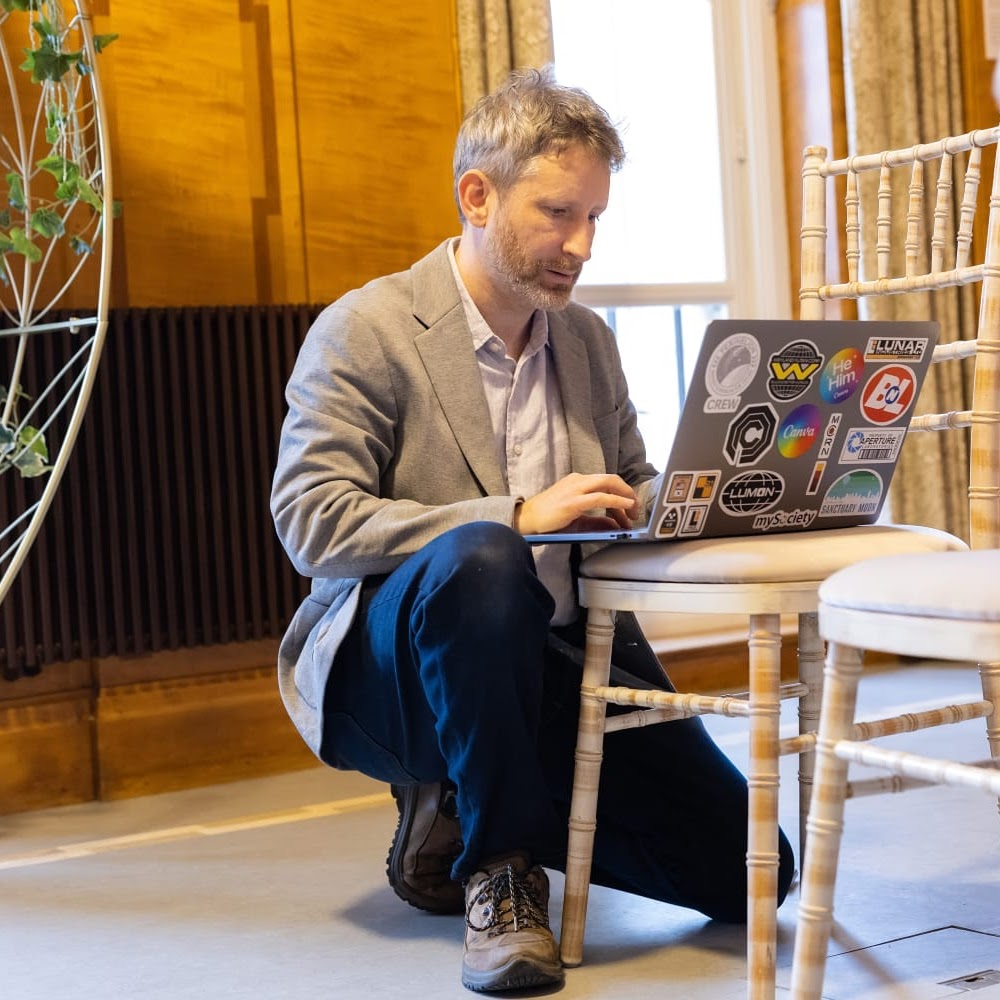
Mark in characteristic pose. I don’t know where I got this photo: if it’s yours,
please let me know if I should attribute or replace.